



Standard
N/A
Tax Portal
N/A
Tax Authority
Ministry of Finance (MoF), VAT Directorate
CTC Model
N/A
B2G
N/A
B2B
N/A
Archiving
10 years
Pending support by DDD invoices
Value added tax (VAT) is budgeted to raise 34.5% of Lebanon's 2026 revenue, yet invoices still follow the VAT Law of 2001. E-invoicing in Lebanon has no legal framework. The Ministry of Finance (MoF) runs VAT through its VAT Directorate.
Lebanon has no e-invoicing mandate, platform or start date. VAT-registered businesses issue tax invoices under Article 38 of the VAT Law and file quarterly returns within one month of quarter end. The standard rate is 11%, and a 12% rate still needs Parliament.
Latest news
On September 18, 2026, IMF staff reported that the Cabinet-approved VAT rise to 12% had yet to be implemented, and urged its legislative enactment. Until then, the standard rate stays 11%.
The 2026 Budget Law, approved by Parliament on January 29, 2026, gives one month instead of 20 days to file periodic VAT returns. Issuers of invoices and receipts now pay the fixed fiscal stamp monthly, declaring it electronically within 15 days after each month. MoF-licensed stamping machine users are exempt.
Tired of scrolling through information about e-invoicing?
- Register on the platform as a software vendor or a end-client
- Start and complete the integration
- Send your first invoice into the test environment
- Switch to production!
What is e-invoicing and has Lebanon adopted it?
E-invoicing means exchanging invoices as structured data that systems process without retyping. Lebanon has not adopted it: no law sets a format, platform, clearance model or go-live date. Invoicing rests on the VAT Law, Law No. 379 of 2001, with its implementing decrees, the 2026 Budget Law and fiscal stamp legislation.
The evolution of e-invoicing in Lebanon
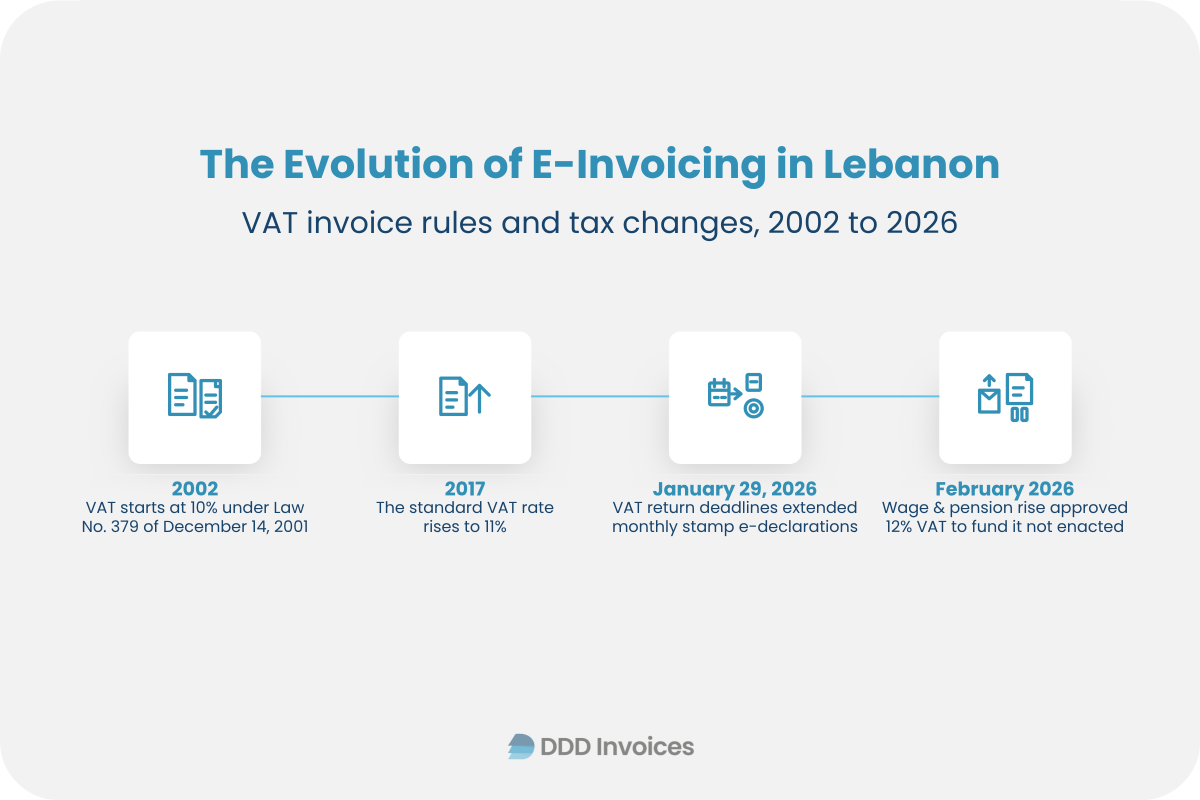
- 2002: VAT starts at 10% under Law No. 379 of December 14, 2001.
- 2017: the standard rate rises to 11%.
- January 29, 2026: Parliament approves the 2026 Budget Law, extending VAT return deadlines and adding monthly stamp e-declarations.
- February 2026: a public wage and pension rise is approved, and the Cabinet-approved 12% VAT rate meant to fund it still awaits enactment.
B2G e-invoicing in Lebanon
B2G e-invoicing is not mandatory, and no government portal for supplier invoices has been announced. Ministries and public bodies receive the same Article 38 tax invoice as business customers.
B2B e-invoicing in Lebanon
B2B e-invoicing is not mandatory either. Under Article 38 of Law 379, every taxable person must issue a tax invoice, or a document serving as one, showing at least:
- the supplier's name, address and MoF registration (VAT) number
- the customer's name and address
- the goods or services supplied
- a serial number and date
- the amount due
- the VAT amount and rate
No rule defines an electronic invoice format, but invoices and records may be kept by computer. To stay compliant:
- Register: mandatory above LBP 5 billion of turnover over one to four consecutive quarters, optional from LBP 1 billion, under the 2024 Budget Law.
- Convert currency: under Article 15 of that law, taxes are collected in Lebanese pounds. Check the exchange rate for foreign-currency VAT with the VAT Directorate.
- Plan corrections: the MoF's invoice guidance does not cover credit or debit notes, so confirm how to document corrections with the VAT Directorate.
- Keep records: keep books and invoices 10 years after the year they cover, in Arabic, with French or English also allowed.
B2C e-invoicing in Lebanon
B2C e-invoicing is not mandatory. Sellers to final consumers may use cash-basis accounting under Decision 294/1 of March 6, 2002. They may then request permission to issue simplified invoices or cash receipts instead of tax invoices.
MoF guidance sets no cash register or real-time receipt reporting duty, so fiscalization models do not apply.
E-reporting and VAT compliance in Lebanon
Lebanon has no periodic e-reporting, and the monthly stamp declaration covers stamp duty only.
- Returns: quarterly, with the return and payment due within one month of quarter end, replacing the earlier 20-day deadline.
- Scope: imports of goods and services are taxable even for unregistered importers. Exports and international transport of goods and passengers are zero-rated, while banking, financial and insurance services are exempt under Article 16.
- Digital sellers: MoF guidance sets no dedicated regime for non-resident digital sellers, so confirm their treatment with the VAT Directorate.
Penalties for non-compliance in Lebanon
Invoice fines under Tax Procedures Law No. 44 of 2008 run from 0.5% of the transaction value to three times the VAT shown.
Offence | Fine |
|---|---|
Not issuing a required invoice | 2% of the transaction value |
Invoice missing the tax number or other formal details | 0.5% of the transaction value |
VAT invoice from an unregistered person | 3 times the VAT shown |
Late or missing VAT return | 5% of the tax due per month, up to 100% |
20% of the difference, at least LBP 6,750,000 for joint-stock companies | |
Late VAT payment | 3% of the unpaid VAT per month |
Your trusted partner for e-invoicing in Lebanon
Lebanon sets no e-invoicing date, so structured e-invoices are voluntary, though sister companies in mandated markets may need to issue and receive them. DDD Invoices can support several legal entities across countries through one integration pattern, with a single archive layer where supported. Talk to the team about your Lebanese ERP invoice flows, since Lebanon is not yet on the country coverage list.
Still have questions?
In the 30min free call we will discuss:
- your requirements in invoicing
- how integration works
- demo of the product
- next steps
FAQs
Is e-invoicing mandatory in Lebanon?
No, Lebanon has no e-invoicing mandate, platform or start date, so structured e-invoices are voluntary. VAT-registered businesses still issue tax invoices under Article 38 of the VAT Law and file quarterly returns.
How do non-residents pay VAT in Lebanon?
Under Decree 7837, non-residents must appoint a local agent at least a week before their first taxable supply. Without one, their contracting party pays the VAT, and resident buyers of foreign services declare it themselves.
What VAT rate applies in Lebanon in 2026?
Lebanon's standard VAT rate is 11%, its only positive rate, unchanged since rising from 10% in 2017. A Cabinet-approved rise to 12% still needs Parliament, and IMF staff urged its enactment on September 18, 2026.
When are VAT returns due in Lebanon?
Quarterly VAT returns are due within one month of quarter end under the 2026 Budget Law. Payment shares that deadline and is made with a payment notice at an approved bank or OMT branch.
Why is Lebanon's fiscal stamp declaration not e-invoicing?
The declaration covers the fixed fiscal stamp fee on invoices and receipts, so it is a stamp-duty filing. No platform clears, validates or delivers Lebanese invoices, and MoF-licensed stamping machine users are exempt from it.


