
Standard
UBL 2.1 XML (ZATCA XML implementation standard); PDF/A-3 with embedded XML allowed
Tax Portal
Fatoora portal
Tax Authority
Zakat, Tax and Customs Authority (ZATCA)
CTC Model
Clearance of standard tax invoices
B2G
2021
B2B
2021
Archiving
6 Years
Pending support by DDD invoices
Saudi Arabia's e-invoicing integration threshold fell from SAR 3 billion in 2023 to SAR 187,500 in 2027, the voluntary VAT registration threshold. E-invoicing in Saudi Arabia is run by the Zakat, Tax and Customs Authority (ZATCA) through its Fatoora platform.
Since December 4, 2021, all resident VAT taxpayers must issue e-invoices from compliant solutions. Phase 2 adds pre-delivery clearance of standard B2B and B2G invoices and 24-hour reporting of simplified B2C ones. Wave 25's integration date, for VAT-taxable revenue above SAR 187,500 in 2022, 2023, 2024 or 2025, is February 1, 2027.
Latest news
On July 24, 2026, ZATCA announced Wave 25 for taxpayers whose VAT-taxable revenue exceeded SAR 187,500 in 2022, 2023, 2024 or 2025. Their integration date is February 1, 2027.
Since July 1, 2026, the extended fines exemption initiative covers only late registration, filing, payment and return-correction fines, so e-invoicing fines stay payable.
Tired of scrolling through information about e-invoicing?
- Register on the platform as a software vendor or a end-client
- Start and complete the integration
- Send your first invoice into the test environment
- Switch to production!
What is e-invoicing and why has Saudi Arabia adopted it?
E-invoicing means exchanging invoices as structured data between seller and buyer. Saudi Arabia uses clearance for standard invoices and reporting for simplified ones, on ZATCA's own platform, not Peppol. ZATCA links the program to digital transformation and credits Phase 1 with stronger consumer protection.
The evolution of e-invoicing in Saudi Arabia
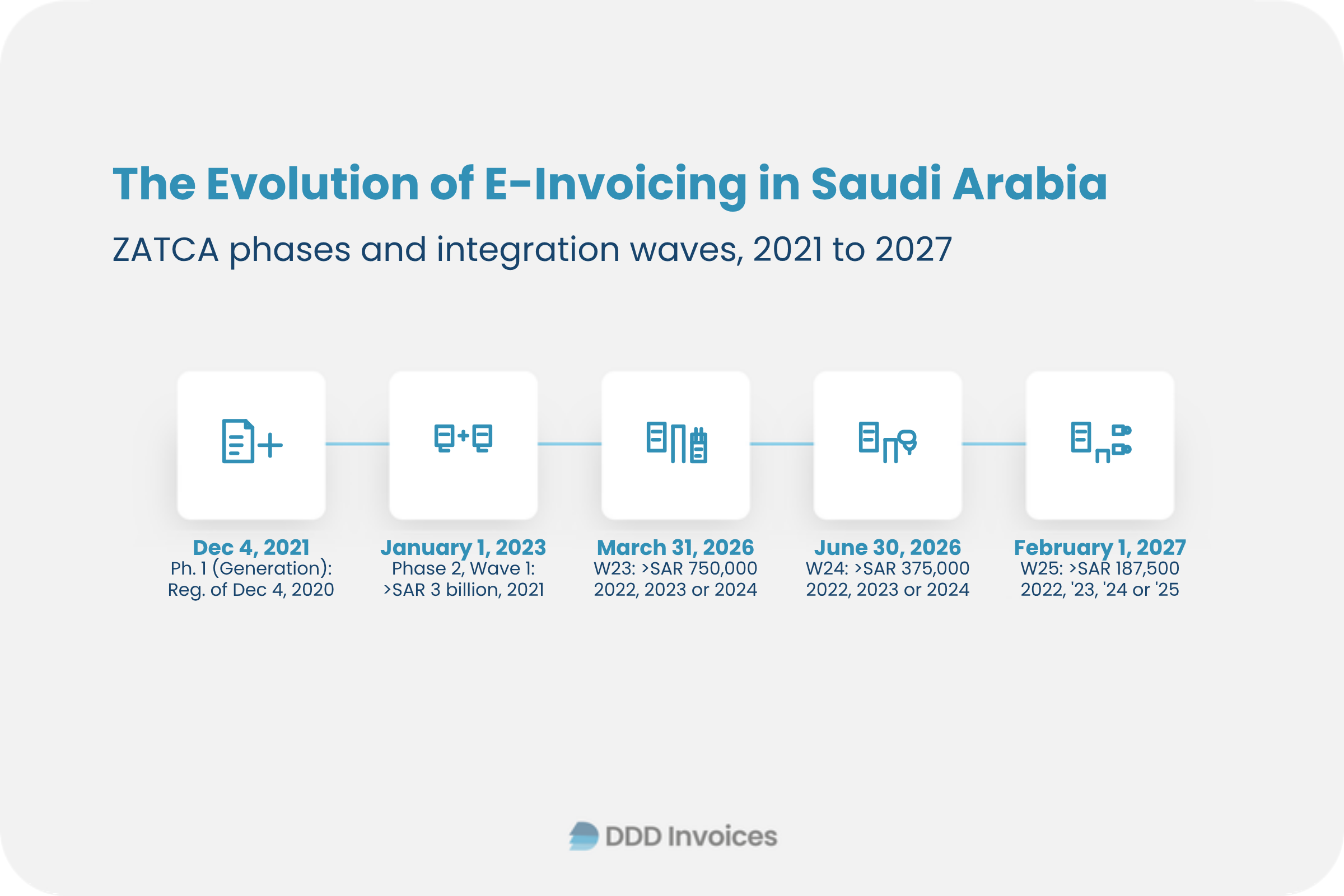
- December 4, 2021: Phase 1 (Generation) applies the E-invoicing Regulation of December 4, 2020.
- January 1, 2023: Phase 2 (Integration) opens with Wave 1, 2021 revenue above SAR 3 billion.
- March 31, 2026: deadline for Wave 23, revenue above SAR 750,000 in 2022, 2023 or 2024.
- June 30, 2026: deadline for Wave 24, revenue above SAR 375,000 in 2022, 2023 or 2024.
- February 1, 2027: integration date for Wave 25, revenue above SAR 187,500 in 2022, 2023, 2024 or 2025.
B2G e-invoicing in Saudi Arabia
Government sales follow the B2B rules and wave dates. ZATCA validates each standard tax invoice and adds its cryptographic stamp before the public buyer receives it.
B2B e-invoicing in Saudi Arabia
B2B e-invoicing is mandatory for resident VAT taxpayers, not non-residents. Phase 2 invoice data is UBL 2.1 XML from tamper-resistant software, with a UUID, counter value, previous invoice hash and QR code. Governor Decision No. 62738 links input VAT deduction to cleared or reported invoices, from a date ZATCA sets later.
Which wave am I in?
Check your VAT-taxable revenue:
- Above SAR 375,000 in 2022, 2023 or 2024: Wave 24 or earlier, whose dates have passed.
- Otherwise above SAR 187,500 in 2022, 2023, 2024 or 2025: Wave 25, integration date February 1, 2027.
- Never above SAR 187,500: no wave yet, with at least six months' notice.
To integrate:
- Request an OTP: sign in to the Fatoora portal with ERAD credentials.
- Get a compliance CSID: each e-invoice generation unit requests this cryptographic stamp identifier.
- Pass compliance checks: the production CSID then unlocks the clearance and reporting APIs in the technical guideline.
B2C e-invoicing in Saudi Arabia
Consumer sales use simplified tax invoices, also allowed for supplies under SAR 1,000. The seller's unit stamps each one, prints it or shares it electronically by agreement, and reports it within 24 hours. Each POS that signs invoices needs its own CSID, much like device fiscalization.
E-reporting and VAT compliance in Saudi Arabia
Saudi Arabia has no periodic e-reporting, since clearance and 24-hour reporting deliver invoice data.
- VAT: 15%, with registration mandatory above SAR 375,000 and voluntary above SAR 187,500, per ZATCA's invoicing guideline.
- Returns: monthly above SAR 40 million of annual revenue, otherwise quarterly, due by the following month's end.
- Corrections: credit (381) and debit (383) notes cite the original invoice.
- Records: 6 years minimum after the tax period, longer for capital assets, 15 years for real estate.
Penalties for non-compliance in Saudi Arabia
Article 4 of the E-invoicing Regulation applies VAT Law penalties, from a warning to SAR 50,000 for general violations.
Offence | Fine |
|---|---|
From SAR 5,000 | |
Deleting or amending an issued e-invoice | From SAR 10,000 |
Missing QR code on a simplified invoice, missing buyer VAT number or unreported malfunction | Warning first |
Other breaches of the VAT Law or regulations | Up to SAR 50,000 |
Same offense repeated within three years | Fine may be doubled |
E-invoicing in Saudi Arabia and the wider GCC
Unlike Saudi clearance, UAE e-invoicing uses Peppol, with firms earning AED 50 million or more live by January 1, 2027. Oman's 5-corner model starts on April 1, 2027 for annual supplies above OMR 5 million. Qatar's Cabinet approved a draft law on May 6, 2026, while Bahrain's National Bureau for Revenue has set no start date. Kuwait has no VAT.
Your trusted partner for e-invoicing in Saudi Arabia
Fatoora integration becomes mandatory for Wave 25 entities on February 1, 2027, and each invoice they issue then needs ZATCA clearance or reporting. DDD Invoices adds tax-portal QR codes and proof data to your existing PDFs through one API connection, pushing status updates back to your ERP. The team can map your received invoice flows and archiving needs now, while Saudi Arabia shows as collecting interest on the country coverage list.
Still have questions?
In the 30min free call we will discuss:
- your requirements in invoicing
- how integration works
- demo of the product
- next steps
FAQs
How does ZATCA clearance work?
Each standard invoice goes to ZATCA's clearance API, which validates it and adds ZATCA's cryptographic stamp. Only the cleared invoice may go to the buyer, and simplified invoices are reported within 24 hours.
What documents does ZATCA's XML standard cover?
ZATCA's XML implementation standard covers tax invoices, simplified invoices, credit notes and debit notes in UBL 2.1. Flags mark self-billed, third-party, export, nominal and summary invoices, and self-billing needs both parties VAT-registered.
When does Wave 25 integrate with Fatoora?
Wave 25 taxpayers have an integration date of February 1, 2027, set in ZATCA's July 24, 2026 notice. It covers taxpayers whose VAT-taxable revenue exceeded SAR 187,500 in 2022, 2023, 2024 or 2025.
Why is a scanned invoice not a Saudi e-invoice?
Article 1 of the E-invoicing Regulation excludes paper invoices converted by copying or scanning from the e-invoice definition. Phase 2 invoices must be XML, or PDF/A-3 with embedded XML, from a compliant solution.