



Standard
N/A
Tax Portal
Dhareeba
Tax Authority
General Tax Authority
CTC Model
N/A
B2G
N/A
B2B
N/A
Archiving
10 years
Pending DDD Invoices support
Qatar collects no VAT, yet it is already preparing to digitize business invoices. The General Tax Authority (GTA) runs taxes through its Dhareeba portal and is expected to oversee e-invoicing in Qatar.
No business in Qatar has to issue e-invoices yet. The Cabinet approved a draft e-invoicing law and executive regulations on May 6, 2026, but the law is not in force. Scope, technical rules, timeline and penalties are unpublished, so companies keep invoicing under current tax and customs rules.
Latest news
Qatar’s Cabinet approved a draft e-invoicing law on May 6, 2026, but it is not yet in force. No scope, format or go-live date has been announced, and Qatar has not applied VAT. Prepare your invoice data and ERP now, and wait for guidance from the General Tax Authority.
The draft law the Cabinet approved on May 6, 2026 is not yet enacted. It must pass the legislative process and the Official Gazette before GTA guidance sets dates, so no go-live date exists.
On November 4, 2026, the GTA extended registration for the Global and Domestic Minimum Tax to January 31, 2027. Large groups registering now should clean entity data, which future e-invoices will also need.
Tired of scrolling through information about e-invoicing?
- Register on the platform as a software vendor or a end-client
- Start and complete the integration
- Send your first invoice into the test environment
- Switch to production!
What is e-invoicing and why is Qatar adopting it?
E-invoicing is the exchange of invoices as structured data that systems read without retyping.
Prepared by the Ministry of Finance with the GTA, the draft law frames the issuing of e-invoices and related notices. Its stated aims are transparency, digital transformation and reliable data for oversight. No model is published; observers expect a phased, possibly Peppol-based rollout from around 2027, which is speculation.
Neighbours move first (last reviewed November 10, 2026). Saudi Arabia's FATOORAH system has applied since December 4, 2021. E-invoicing in the UAE runs on Peppol from January 1, 2027 for revenue of AED 50 million or more. Oman's Decision No. 189/2026 starts Peppol-based e-invoicing on April 1, 2027 above OMR 5 million. Bahrain is preparing, and Kuwait has no VAT.
The evolution of e-invoicing in Qatar
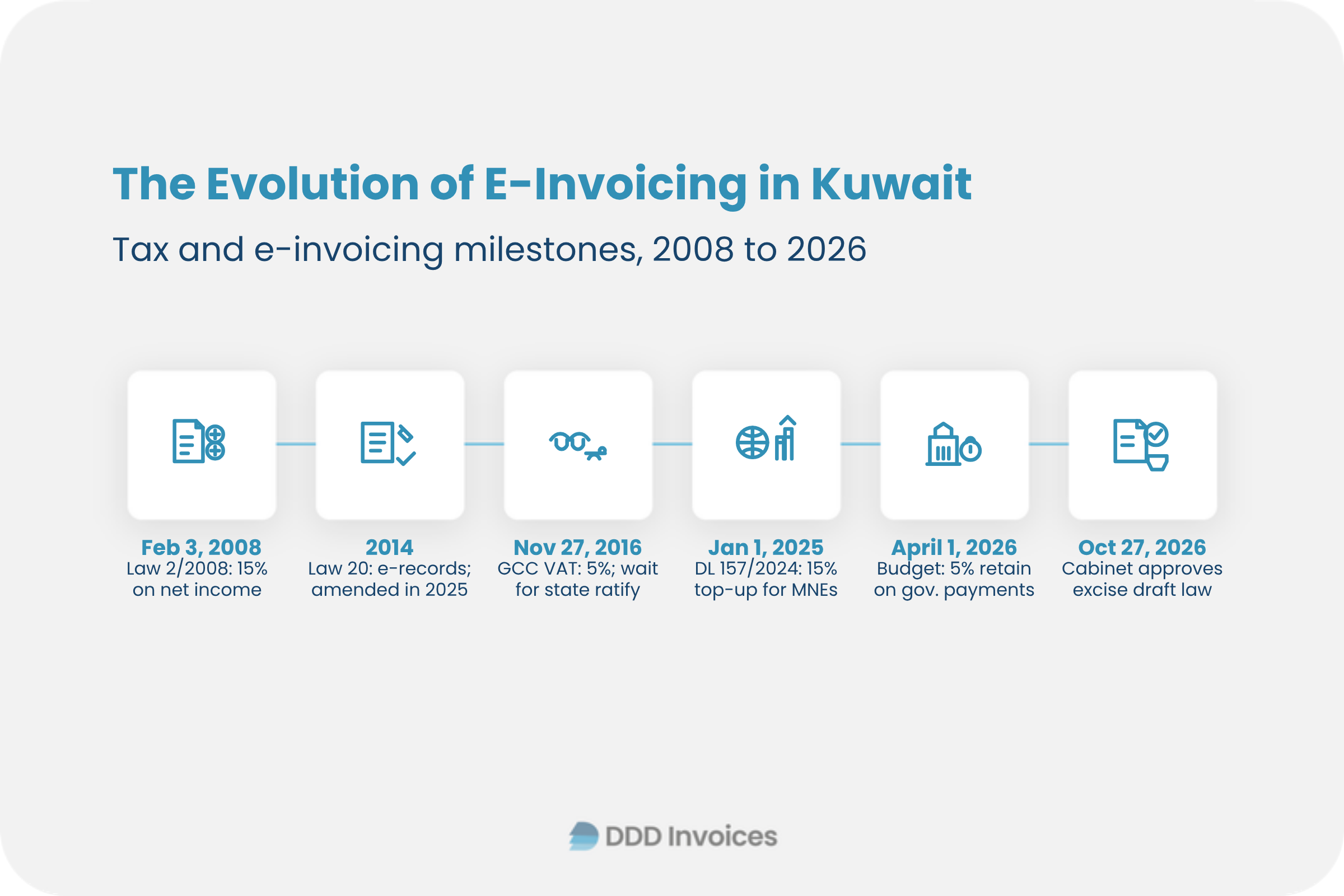
- December 13, 2018: Law No. 24 of 2018 sets income tax at 10% of taxable income.
- January 1, 2019: the Excise Tax Law, Law No. 25 of 2018, takes effect.
- January 1, 2025: a 15% global minimum tax applies to large groups under Law No. 22 of 2024.
- May 6, 2026: the Cabinet approves the draft e-invoicing law and its executive regulations.
- Next: legislative process, Official Gazette publication, then GTA guidance on scope and dates (none set).
B2G e-invoicing in Qatar
B2G e-invoicing is not mandatory, and no government e-invoice portal or format exists. Under Decree-Law No. 16 of 2010, government entities must give explicit consent before dealing electronically. Whether the draft law covers B2G is not yet confirmed.
B2B e-invoicing in Qatar
B2B e-invoicing is not mandatory. Suppliers send commercial invoices directly to customers, on paper or electronically by agreement, with no GTA validation. Imports pay customs on the CIF invoice value under the GCC Unified Customs Law.
- Register: on Dhareeba within 60 days of commercial registration or first income, under the Income Tax Law regulations.
- Clean master data: correct customer names, addresses and tax numbers.
- Structure output: prepare your ERP to produce invoice lines as data fields, not only PDFs.
- Plan connectivity: ready an API route for invoice data.
- Monitor: follow the Official Gazette and GTA announcements.
B2C e-invoicing in Qatar
B2C e-invoicing is not mandatory, and Qatar has no fiscal device, e-receipt or till certification rule. Retailers keep their current POS systems for now.
E-reporting and VAT compliance
Qatar has no periodic e-reporting, and the GTA states that Qatar has not applied VAT. Qatar is party to the GCC VAT Agreement, and its Cabinet approved a draft VAT law in May 2017, never published. Whether e-invoicing arrives alone or with VAT remains open.
These taxes apply today:
- Income tax: 10% of taxable income, with Qatari owners' share exempt; returns due within four months of year-end.
- Excise tax: 100% on tobacco, energy drinks and special-purpose goods; sweetened drinks pay QAR 0.77 or 1.06 per liter from July 6, 2026.
- Withholding tax: 5% on royalties, interest, commissions and service fees paid to non-residents.
- Minimum tax: 15% for groups with revenue of EUR 750 million in two of the four preceding years.
- Customs: 5% of CIF value under the GCC tariff.
Keep books, records and documents for 10 years under Article 36 of Cabinet Decision No. 39 of 2019. Electronic records are allowed if the system prevents tampering and gives the GTA access within Qatar.
Penalties for non-compliance
Qatar has no e-invoicing penalties; income tax fines reach QAR 180,000 for late returns under Article 24 of the Income Tax Law.
Offence | Fine |
|---|---|
Not issuing an e-invoice | Not applicable, no mandate |
Late income tax return (Art. 24) | QAR 500 per day, up to QAR 180,000 |
Late tax payment (Art. 24) | 2% of the tax due per month, up to the tax due |
Registration or notification breach (Art. 24) | QAR 20,000 |
Missing accounting records or audited accounts (Art. 24) | QAR 30,000 |
Tax evasion, such as forged records (Art. 26) | Up to 1 year in prison and up to 3 times the tax due |
Your trusted partner for e-invoicing
Qatar's format is still unpublished, so the smart move is structuring invoice data once and mapping it later.
DDD Invoices links your ERP to one compliance API to issue, receive and archive e-invoices, with testing and format updates included. Qatar is not yet on our country coverage list, so share your Gulf entities and we will map the route together.
Still have questions?
In the 30min free call we will discuss:
- your requirements in invoicing
- how integration works
- demo of the product
- next steps
FAQs
Is e-invoicing mandatory in Qatar?
No, e-invoicing is not mandatory in Qatar, because the May 2026 draft law is not in force. Scope, technical rules and the go-live date will follow in the executive regulations and GTA guidance.
Does Qatar have VAT?
No, Qatar has not applied VAT, although it is party to the 2016 GCC VAT Agreement. Its Cabinet approved a draft VAT law in May 2017, but that law was never published.
When will e-invoicing start in Qatar?
No start date has been published, and the draft law still needs enactment and gazette publication. Industry observers expect a phased rollout from around 2027, but the GTA has not confirmed it.
How should businesses in Qatar prepare for e-invoicing?
Start by cleaning customer master data and making your ERP output invoice lines as structured fields. Then plan API connectivity and monitor the Official Gazette and GTA announcements for final rules.


